Tuesday, April 2, 2013

The Quirky Town of Oatman, Arizona


Oatman was "resurrected" by a few hardy souls after the mines played out.   These creative folk decided to re-invent Oatman as a quintessential mining town that in modern times "poked fun at itself".   The re-invention was made more colorful via inclusion of the wild burros, who today are very much a center of attention to the wonderful, little, quirky town of Oatman Arizona.

Oatman has lots of interesting (and cute) signage.....these photos will help to describe the kind of town we four visited today....the UK cousins thought it was a wonderful experience......hold on to your hats.....here is Oatman, as told by its signs:


So there you have Oatman.....we think it speaks for itself......and here are two more to close in style....


The UK cousins on the left.....and GUESS WHO above.....!!

(Oatman is worthy of  most Bucket Lists.....!!)


HOOVER DAM


The Hoover Dam is a wonder.   Begun in 1931 in the midst of the Great Depression, the last concrete was poured in 1935....and despite its remote location and harsh working conditions, the six companies contracted to build the dam did so in underbudget fashion and finished 2 years ahead of schedule.   (Try to find results like that today!!).
 
The Boulder Canyon Project Act, as it was known, authorized Hoover Damd for "flood control; improvement of navigation and regulation of the Colorado River; storage and delivery of Colorado River waters for reclamation of public lands and other beneficial uses exclusively within the United States; and hydroelectric power production.   The water storage and river control provided by the Hoover Dam and other downstream projects enable residents of the Southwest to use the waters of the lower river for many uses.....including
 
  • Irrigation of more than one million acres of some of America's richest croplands and nearly half a million acres in Mexico;
  • Meeting the domestic water needs of some 25+ million people in Las Vegas, Los Angeles, San Diego, Phoenix, Tuscon and other southwestern cities and towns as well as Indian communities in Arizona, Nevada and California.
  • Generation of low cost hydroelectric power for use in Nevada, Arizona and California.
Turbines that provide the hydroelectric Power of the Dam.
The Colorado River with the post 9-11 "sky bridge" hovering hundreds
of feet above the river.   We drove across this bridge in the motorhome
en route from Arizona to Nevada.


John and Alison with the new Hoover Dam Bridge in the background.

Nearly a century has passed since Hoover Dam rose from the bed of the Colorado River, but there appears to be no end to peoples' fascination with this awe inspiring achievement.  Although more modern dams are taller or generate more power, Hoover continues to lure millions of visitiors from across the nation and around the world.  It is indeed a marvel of both engineeering and design as well as a monumental testimony to the workers who labored 7 days a week to build this man made wonder.


LAS VEGAS

We 'splurged' and rented a lot in the Las Vegas Motorcoach Resort for a week.   The resort is exclusive to Class A rvs and the lot was 'kitted out' with a California Kitchen.....outdoor cooking area complete with tiki umbrellas.   After spending many nights on our trip in Walmart parking lots we decided to upgrade for the week.

Pam & I showing off our new 'tour fleeces' presented to us by John & Alison.
(A Great & Unique Gift!)


The Penguins are on hand to help grill up a meal at the Las Vegas Motorcoach Resort.

One of our first items on the agenda was to explore Hoover Dam and Red Rock Canyon...as well as make a visit to the Las Vegas strip to see the night light shows.   During our visit to the strip we parked at the Bellagio and took in the flower show in the lobby area....many gorgeous real flowers and some exquisite glass blown flower creations as well.   Take a look at some of it.....


The creations were first rate.....to the left you can see two lady bugs totally made from flowers.  Butterflies hung from the ceiling everywhere and there were mushroom pedestals and other natural wonders all replicated with live flowers.
 
Fortunately, we were told about the flower display by one of the folks who live full time in their motorcoaches at the resort.    John and Alison loved the opportunity to see Vegas up close and personal with the bright lights of the strip, the flower adorned lobbies of the Bellagio Hotel and the hotel's swanky casino, complete with high rollers.
 
More from Nevada later....including Red Rock Canyon and the Hoover Dam.   Stay tuned......


Monday, April 1, 2013

THE GRAND CANYON

Enjoy these views of the Grand Canyon.....incl. this one where some young adults got way too close to the edge for comfort.... 

Nothing is like the majesty of the Grand Canyon
2+ million years of development...

Pam's first look at the Grand Canyon
 

Also, Pam's first driving lesson....


The British are coming....the British are coming....
(our welcome tribute to John & Alison Currah from Cornwall, England...they

have come to spend two weeks with us).


Sunday, March 24, 2013

A Potpourri of our moving about this past week....

Pam with Jim & Sharon Bailey
(they had not seen each other in 20 years)

Cathedral Rock in Sedona....(lots more to come from here in 2 weeks)
The Grand Canyon......(lots more to come from here in 2 weeks).


There are pretty nice views from nearly every point in Sedona.....this one from the Javelina Restaurant, where we met Jim & Sharon for lunch.


Pam and I found a  nice Amish restaurant here.....not something
one would expect in the middle of the high desert.


The vastness of the American West never ceases to amaze.....and does that sign say 'Cameron'?
(stay tuned to find out more)
 
 
The White Mountains near Flagstaff, Arizona
(makes us think of our White Mountains back home).
 
Next blog from Nevada!!


THE PETRIFIED FOREST NP


Petrified wood found in the park and the surrounding region is made up of almost solid quartz. Each piece is like a giant crystal, often sparkling in the sunlight as if covered by glitter. The rainbow of colors is produced by impurities in the quartz, such as iron, carbon, and manganese.

Over 200 million years ago, the logs washed into an ancient river system and were buried quick enough and deep enough by massive amounts of sediment and debris also carried in the water, that oxygen was cut off and decay slowed to a process that would now take centuries.

Minerals, including silica dissolved from volcanic ash, absorbed into the porous wood over hundreds and thousands of years crystallized within the cellular structure, replacing the organic material as it broke down over time. Sometimes crushing or decay left cracks in the logs. Here large jewel-like crystals of clear quartz, purple amethyst, yellow citrine, and smoky quartz formed.


The Petrified Forest was set aside as a national monument in 1906 to preserve and protect the petrified wood for its scientific value. It is recognized today for having so much more, including a broad representation of the Late Triassic paleo-ecosystem, significant human history, clear night skies, fragile grasslands ecosystem, and unspoiled scenic vistas.
 
Scientific studies are on-going at the park. Paleontologists find new fossils, including new species of plants and animals, each year. Biologists study living plants and animals, including vegetation surveys and reptile, amphibian, and mammal projects. Air quality, weather, and seismic monitoring stations constantly generate new data.


Here a plateau is dotted with several examples of the petrified wood that has now become condensed, very heavy quartzlike stone.
 

An explanation of the Triassic Landscape (again, small print but readable).
 
The Petrified Forest and the Painted Desert join together to make up two distinct, yet interlaced natural wonders in the same region of Northeast Arizona.  It took tens of millions of years to dot the landscape with the desert art we now call the 'painted desert'....and it took a similar amount of time to bury large pine trees and isolate them from the very things they needed to even decay, let alone live....and to transform them into the beautiful "chunks of petrification" we enjoy in the park today.
 
As we visit the National Parks on this trip it is clear to us that they need to be preserved for future genterations.....yes, money is tight everwhere in government these days....but these natural wonders must be protected and preserved so others can come and experience the history and beauty and the spirituality that we have experienced.
 
Today is our last day in Williams, AZ.   Tomorrow we point the bus in the direction of Las Vegas, some 3 1/2 hours north and west of here; where we will set up in yet another RV campground.  And Thursday PM of next week Pam's cousin John Currah and his wife, Alison, fly in from Cornwall, England to join us for two weeks of visiting the American West.   We can't wait to see them and to experience much of the vast beauty theWest has to offer....to include the Grand Canyon.   Pam, like her cousins, has not seen the Grand Canyon.....and Amy Remick will be joining us for week #2 of our adventures.....so we are off today to give Pam her first glimpse of what is truly one of nature's great wonders.....the Grand Canyon.   See you next week.....John and Alison....safe travels.
 
In closing the blog....here are a few more photos of the Painted Desert....


Saturday, March 23, 2013

THE PAINTED DESERT .....


The Painted Desert is a United States desert of badlands in the Four Corners area from the Grand Canyon National Park and into the Petrified Forest National Park.

Now.....here's where we have to get technical....so take a deep breath and pay attention.....!!!

The desert is composed of stratified layers of easily erodible siltstone, mudstone, and shale dating back to the Triassic Period (several millions of years ago). These fine grained rock layers contain abundant iron and manganese compounds which provide the pigments for the various colors of the region. Thin resistant limestone layers and volcanic flows cap the mesas. Numerous layers of volcanic ash occur in this Chinle Formation region (named for the nearby Navajo town of Chinle) and provide the silica for the petrified 'logs' of the area. The erosion of these layers has resulted in the formation of the what is called "the badlands" topography of the region.  (whew!!).
The bottom line is these stratified layers of stone provide multiple colors and can appear to change quite dramatically at various times of day due to how they are lighted by the sun.

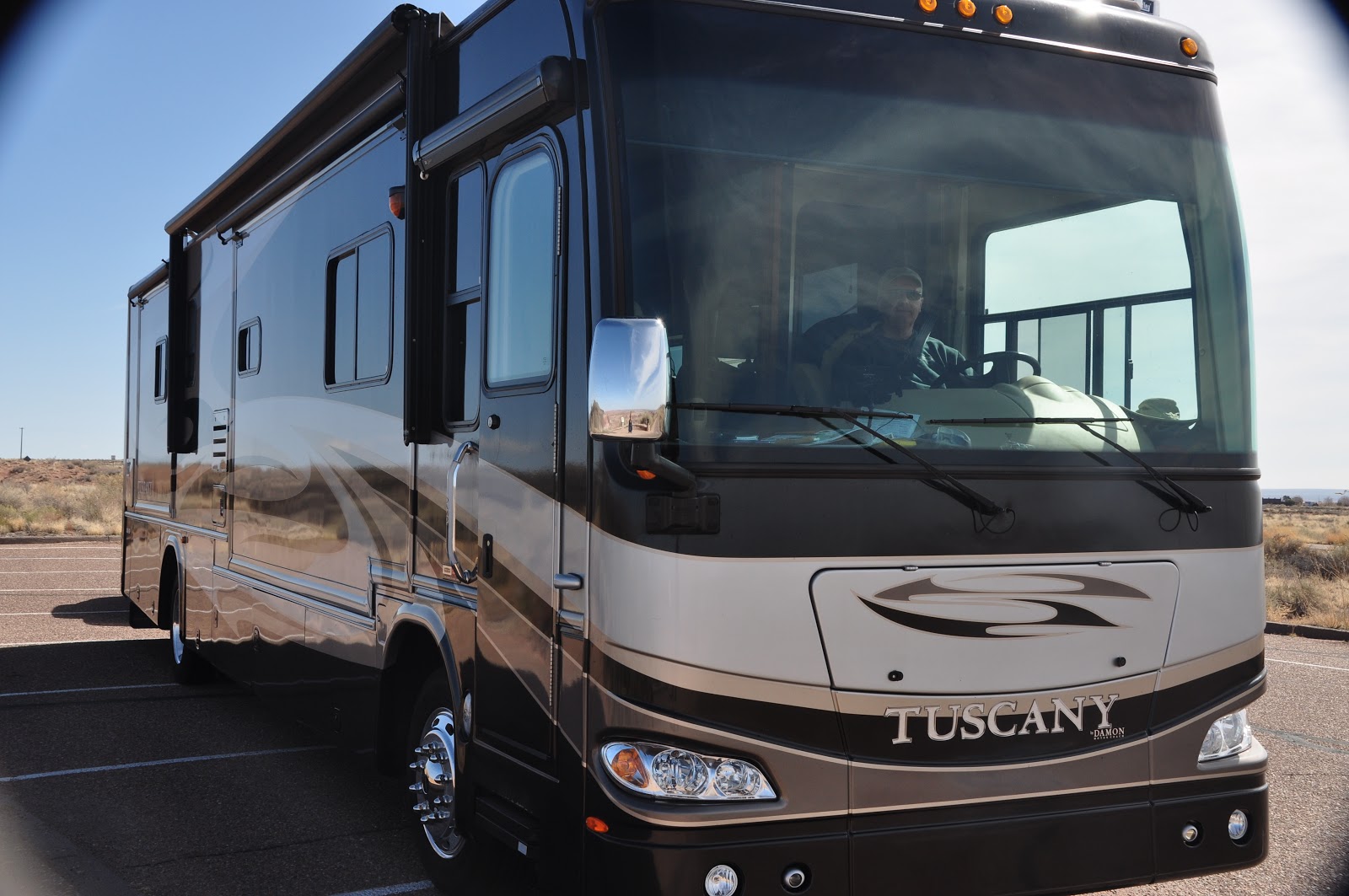
The park has decent, albeit narrow, roads and very good pulloffs, thus allowing us to drive through and see the petrified logs and the painted desert with the motorhome and without having to unhook the Mini.....makes life a bit easier when these circumstances present themselves......here we are at a pulloff stop


This is a good time to note that Photos in this blog are courtesy of Pam....since I was driving she clicked away....and during the few times we stopped, she kept on taking photos.....a good job, eh?


And she clicked this one as I very patiently waited for her to finish up her photo session......!

An explanation of The Badlands Topography....(print is small but it is readable)


Enjoy these following photos of the Painted Desert........


The Painted Desert is yet another example of Nature at work....in the natural world art is everywhere....we simply have to keep our eyes open and notice it........

Next Issue....the Petrified Forest.